Kerülje el a késedelmes válaszadást, kérjük, írja be WhatsApp/Skype-ját az üzenettel együtt, hogy az első alkalommal fel tudjuk venni Önnel a kapcsolatot.
We will reply you within 24 hours. If for urgent case, please add WhatsApp/WeChat: +8613791936882 ,. Or call +86-18678911083 directly.
When plants are moved too often, displayed poorly, or shipped on weak carts, growers lose time, space, and sales. A better trolley fixes that. The right danish system protects products, speeds up work, and makes buyers more willing to contact a reliable supplier.
A Danish Flower Pot Cart is a multi-level rolling flower trolley built for greenhouse, nursery, and garden retail work. It helps teams move, organize, and present flowers and plants with adjustable shelves, galvanized steel, and smooth casters. When sourced from a capable China factory, it can also be customized for size, shelf type, branding, and export packaging.
A normal cart only moves products from one point to another. A danish trolley does more. It is built to move, hold, show, and protect living products during daily work. On the CNFS Group product page, the Dán virágcserepes kosár is presented as a practical solution for transporting and displaying flower pots in greenhouses, nurseries, garden centers, and floral distribution networks. That one sentence already shows why this format has staying power: it combines transport and display in one mobile unit.
This matters because flowers and potted goods are not handled like boxed parts. A trolley in the flower and plant business must support quick loading, easy movement, clean presentation, and stable shelf spacing. In real operations, one unit may go from growing area to packing zone, then to retail floor, then back into return flow. That is why many buyers stop calling it a simple cart and start treating it as part of their operating system. In short, the danish trolley is specially designed to reduce handling, save labor, and improve product presentation at the same time.
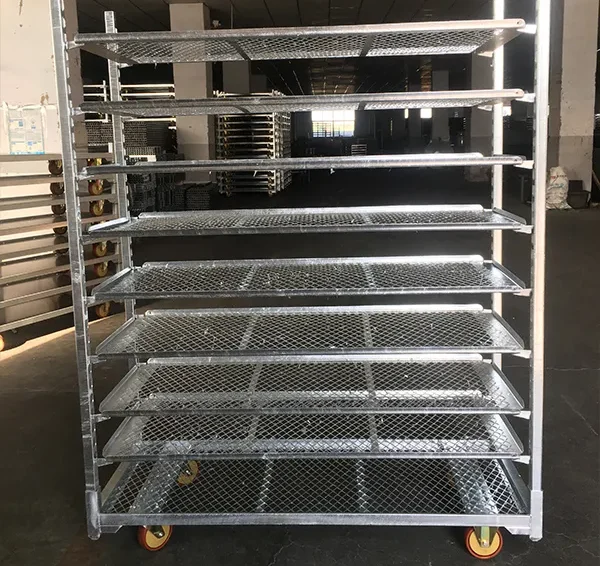
Most buyers in this space face the same four issues: too much manual handling, poor space use, weak carts, and inconsistent presentation. CNFS Group clearly targets greenhouse, nursery, garden center, floral distribution, and retail users, which means the company understands that these buyers are moving sensitive products in wet, busy, time-sensitive environments.
The real challenge is not only movement. It is movement plus order. Plants come in different heights, different pot sizes, and different sales cycles. Teams need a mobile rack that can be adjusted fast, rolled through narrow aisles, and used for both back-room work and front-end selling. CNFS says its shelves can be repositioned in 50 mm increments and its application area includes warehouse, logistics, plant and flower industry, and propagation rooms. That is exactly the kind of flexibility serious buyers look for.
A well-built plant trolley improves work in three clear stages: move, show, and store. During movement, it reduces the number of times workers touch the product. During display, it creates a neat, layered presentation. During return or idle time, it saves floor space because shelves and posts can be removed or adjusted. CNFS says its Dán virágcserepes kosár has a nestable frame, adjustable shelving, and disassemblable parts that help optimize storage space and reduce return shipping cost.
This is why a danish flower trolley fits both logistics and selling. In a warehouse, it supports sorting and staging. In a retail area, it becomes a clean, upright display platform. In a propagation room, it keeps plants organized by stage, route, or buyer. The same product page also lists greenhouses, nurseries, garden centers, wholesale floral distribution, and event floristry as application scenarios, showing that the unit is designed for flexible use across the supply chain.
One fixed frame does not suit every crop. A trolley used for short pot plants today may be needed for taller flowering stock tomorrow. That is why shelf adjustment is such an important selling point. CNFS says its shelves are configurable in 50 mm increments, and its product structure uses four posts with equally spaced holes so the shelf height can change based on plant height. The number of shelves can also be increased or reduced according to need.
That flexibility directly supports sales and operations. In a garden center or floral wholesaler, mixed heights are normal. Buyers may need one setup for small pot stock, another for fuller flowering lines, and another for fast restocking runs. A rigid frame wastes space. A multi-level trolley with an adjustable shelf layout helps each square meter work harder. This is especially useful for buyers who want a single product to handle both transport and display.

Shelf material changes how the trolley performs. CNFS notes that shelf style can be customized, and the company presents different trolley and shelf solutions for various user needs. On the Danish Flower Pot Cart page, the standard unit is shown with three shelves, while the company also states that shelf count can be increased or decreased according to the application.
In practice, buyers usually compare three directions: wire mesh, plywood, and solid metal shelf options. Wire mesh is useful where airflow and drainage matter. Plywood often works well for general flower and plant movement because it gives broad support. Metal shelves can suit a more industrial, heavy duty, or easy-clean requirement. The best answer depends on the product mix, moisture level, and how often the trolley moves between growing, staging, and retail spaces.
For buyers, this is also where customization starts to feel real. They are not forced into one fixed spec. They can choose a shelf type that matches their products, routes, and customers. That helps turn interest into action.
A trolley used in horticulture lives in a hard environment. Water, fertilizer, dirt, loading ramps, and rough handling all put pressure on the frame and casters. CNFS says the Dán virágcserepes kosár is made from hot-dip galvanized steel and offers strong corrosion resistance in wet and humid environments. The product parameter section also lists finish options as electric galvanized or hot galvanized.
That makes the finish a core buying point, not a side detail. A rust-prone frame may look cheap at first, but over time it costs more in maintenance, replacement, and disrupted workflow. A galvanized frame is more resistant and more suitable for daily use in a greenhouse, nursery, or humid dispatch area. For many buyers, that is the difference between a short-life unit and a long-life asset.
Wheel quality matters just as much. CNFS says the unit uses four swivel casters, two with brakes, and that wheel material can be chosen. Good caster selection affects noise, control, floor protection, and roll performance. A weak wheel or poor bearing setup can ruin a good frame. So when buyers compare offers, they should look beyond the main structure and ask about caster type, brake quality, floor suitability, and daily load conditions.
Freight cost is not only about how much a trolley weighs. It is also about how much space it takes. CNFS explains that shelves can be disassembled when not in use to optimize storage space and reduce return shipping cost. The site also highlights a space-saving nestable design, which is a powerful message for buyers running repeated deliveries, backhauls, or seasonal peaks.
This is why many professional buyers prefer a collapsible or partly dismantled format over a fixed welded rack. When a trolley can be broken down into base, posts, and shelves, it becomes easier to store, easier to return, and easier to handle in bulk. That matters in export projects, cross-regional delivery, and multi-site distribution. Even a small improvement in packed volume can create meaningful savings over time.

Customization is where many inquiries are won or lost. CNFS clearly says OEM/ODM is available for size, color powder coating, logo branding, RFID/barcode tracking, pull nets, and caster upgrades. On the About page, the company also describes its custom service flow, from understanding product size, color, and material needs to mass production and after-sales support.
For overseas buyers, those options are not extras. They are often required. A wholesaler may want a specific size. A regional distributor may need a branded platform for resale. A retail group may want a cleaner display finish. A logistics buyer may need different wheels or a pull-net setup. This is why danish trolleys offer more than transport value. They can be shaped around route, product type, and market position.
The most common custom requests usually include:
For a buyer reading your homepage, these details create confidence. They show that CNFS Group is not only selling a standard unit. It can customize a real solution.
Many buyers prefer direct factory communication when they want better control over price, specification, and lead time. CNFS states that Qingdao Fangsheng Technology Co., Ltd. was established in 2015 as a modern machinery manufacturing enterprise integrating research and development, production, and sales. It also states that the factory covers more than 10,000 square meters and has annual production capacity of more than 200,000 sets.
Those details matter because they signal stable supply. CNFS also passed ISO9001 in 2021, offers one-stop service, has rich export experience, and provides 24-hour after-sales response. The company products are sold in over 60 countries and that it has offices in Germany and the Netherlands. For importers, that combination of production scale, export history, and service language creates trust.
Of course, not every buyer should choose the lowest quote from overseas. The smarter move is to compare total value: factory access, technical communication, consistency, custom service, and post-sale support. When those pieces are strong, a China source can be the safer long-term supplier, not just the cheaper one.

CNFS Group is not positioned as a single-product seller. The company as a broader manufacturer with product lines including Danish trolleys, flower trolleys, horticultural and warehouse transport equipment, lawn mowers, dump trucks, and sheet metal products. That broader capability is useful for buyers who may start with one trolley line and later expand into other support equipment or custom metal products.
The company also leans hard into service language that matters for repeat business: professional design, strict quality control, one-stop service, fast delivery, and 24-hour after-sales support. For a buyer in the horticulture industry, that means fewer unknowns. You are not just buying a product. You are building a supply relationship with a factory that already speaks to export buyers and understands the needs of growers, nurseries, garden centers, and distributors.
It is used for moving, organizing, and presenting potted flowers and plants in greenhouses, nurseries, garden centers, warehouses, and floral distribution environments.
Yes. CNFS specifically lists greenhouses and nurseries among the main application scenarios, and the galvanized frame plus adjustable shelves make the product suitable for humid and changing horticultural conditions.
Yes. CNFS says the shelves are adjustable in 50 mm increments and that the number of shelves can be increased or decreased based on user needs.
Galvanized steel helps the trolley resist rust and corrosion in wet or humid environments. That is especially important for daily horticultural use, where water and fertilizer exposure are common.
Yes. CNFS supports OEM/ODM for size, coating color, logo branding, RFID or barcode tracking, pull nets, and caster upgrades.
A factory-direct supplier can offer better control over customization, production communication, lead time, and total project cost. CNFS as an ISO9001-certified manufacturer with over 10,000 square meters of factory area, more than 200,000 sets of annual capacity, exports to 60+ countries, and offices in Germany and the Netherlands.


 Hungarian
  English
  German
  French
  Dutch
Dutch  Spanish
  Danish
  Norwegian
  Turkish