Om te voorkomen dat uw vraag te laat wordt beantwoord, verzoeken wij u om uw WhatsApp/Skype-bericht mee te sturen met het bericht. Zo kunnen wij direct contact met u opnemen.
We will reply you within 24 hours. If for urgent case, please add WhatsApp/WeChat: +8613791936882 ,. Or call +86-18678911083 directly.
Moving plants looks simple until weak trolleys slow your team, damage goods, and raise hidden costs. In busy greenhouse, nursery, garden center, and logistics work, a strong Danish trolley solves these problems with reliable transport, flexible display, and long service life.
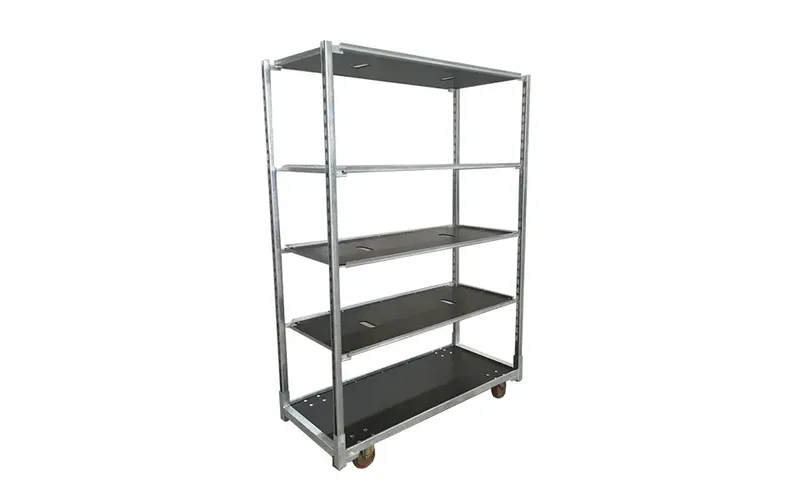
A Deense trolley is a modular plant transport and display trolley widely used in horticulture, flower logistics, garden centers, nurseries, supermarkets, and warehouses. It usually has a steel frame, upright posts, adjustable shelves, strong wheels, and removable components, making it easy to move, store, display, and ship flowers and plants in bulk.
For greenhouse growers, nursery operators, garden centers, and flower logistics teams, the trolley is not a small tool. It is a daily work partner. It helps workers move plants, organize orders, prepare shipments, and create clean retail displays.
A weak trolley can bend, shake, rust, or lose wheels. That causes delays. It may also damage flowers and plants during movement. In a busy season, one bad cart can affect many orders. This is why professional buyers care about service life, delivery stability, and total cost, not only the first purchase price.
As a Danish Trolley, Garden Carts and Trolley manufacturing plant, we look at the product from the user’s daily work. Buyers do not only need a frame with wheels. They need a dependable system for transport, order picking, display, storage, and repeat use.
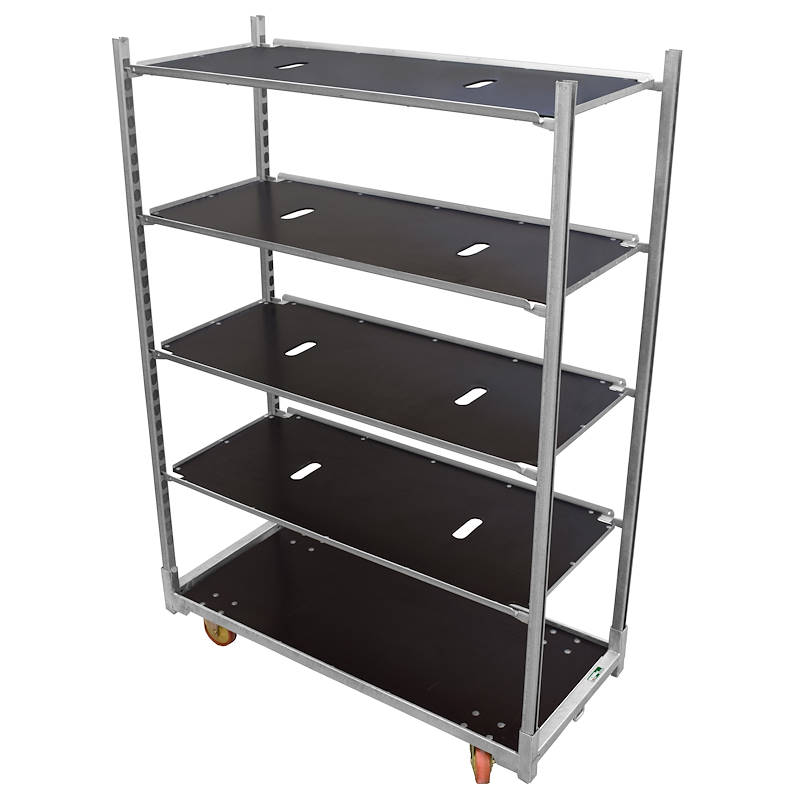
A common cart may only have a flat base and a handle. A Deense trolley is more flexible. It is usually built with a base, upright posts, removable shelves, and strong wheels. This structure allows users to adjust the space for different plants and flowers.
The key value is modular design. Workers can add shelves, remove shelves, change loading height, and use the same trolley for different tasks. One day it may carry seedlings. The next day it may hold potted plants. Later, it can become a flower display in a garden center.
Many buyers also call it a danish container, plant trolley, Danish flower trolley, or flower trolley. In some markets, buyers may compare it with CC containers or danish carts. The purpose is similar: make plant handling easier, safer, and more cost-effective.
Plant handling is full of small steps. Workers move products from growing areas to sorting areas, from sorting areas to loading zones, and from loading zones to trucks or retail displays. A stable trolley reduces hand carrying and improves workflow.
In greenhouse and nursery operations, the trolley helps with moving plants and flowers while reducing product damage. Workers can place trays, pots, and flowers on shelves instead of stacking them badly. This helps protect leaves, stems, blooms, and packaging.
For logistics and warehouse teams, a trolley also supports order picking. Staff can collect mixed items, move them together, and prepare them for delivery. A smooth-rolling design makes the trolley easy to transport, even when the load is high.
Plants do not come in one size. Some are short. Some are tall. Some need wide space. Some sit in trays. This is why adjustable shelves are one of the most important features of a professional Danish trolley.
With an adjustable design, workers can change the shelf height to match plant size. A buyer can shelve small plants closely to increase capacity. The same buyer can later shelve taller products with more open space. This makes one trolley useful across many seasons.
For garden center and nursery or garden retail use, this flexibility is very helpful. A trolley may carry bedding plants in spring, patio plants in summer, and holiday greenery in winter. One product can support many sales cycles.
The wheel system affects safety, noise, movement, and labor cost. A low-quality wheel may jam, crack, or shake. A strong wheel helps workers move the loaded trolley with less effort. In retail areas, this also improves the shopping experience because the trolley moves quietly and smoothly.
Buyers should check wheel material, diameter, brake options, and floor suitability. Common choices include polypropylene, nylon, rubber, PU, and TPR. For better turning, a swivel wheel or swivel castors can improve maneuverability and manoeuvrability in tight aisles.
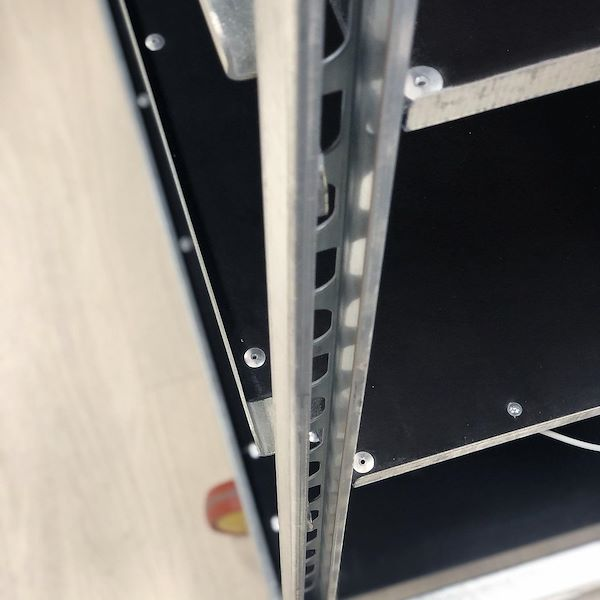
The frame matters too. A strong steel frame, good weld quality, and robust construction help the trolley carry weight safely. A galvanized or powder-coated finish can improve weatherproof performance for humid greenhouse areas and outdoor conditions.
How Can Danish Trolleys Support Flower Display and Retail Sales?
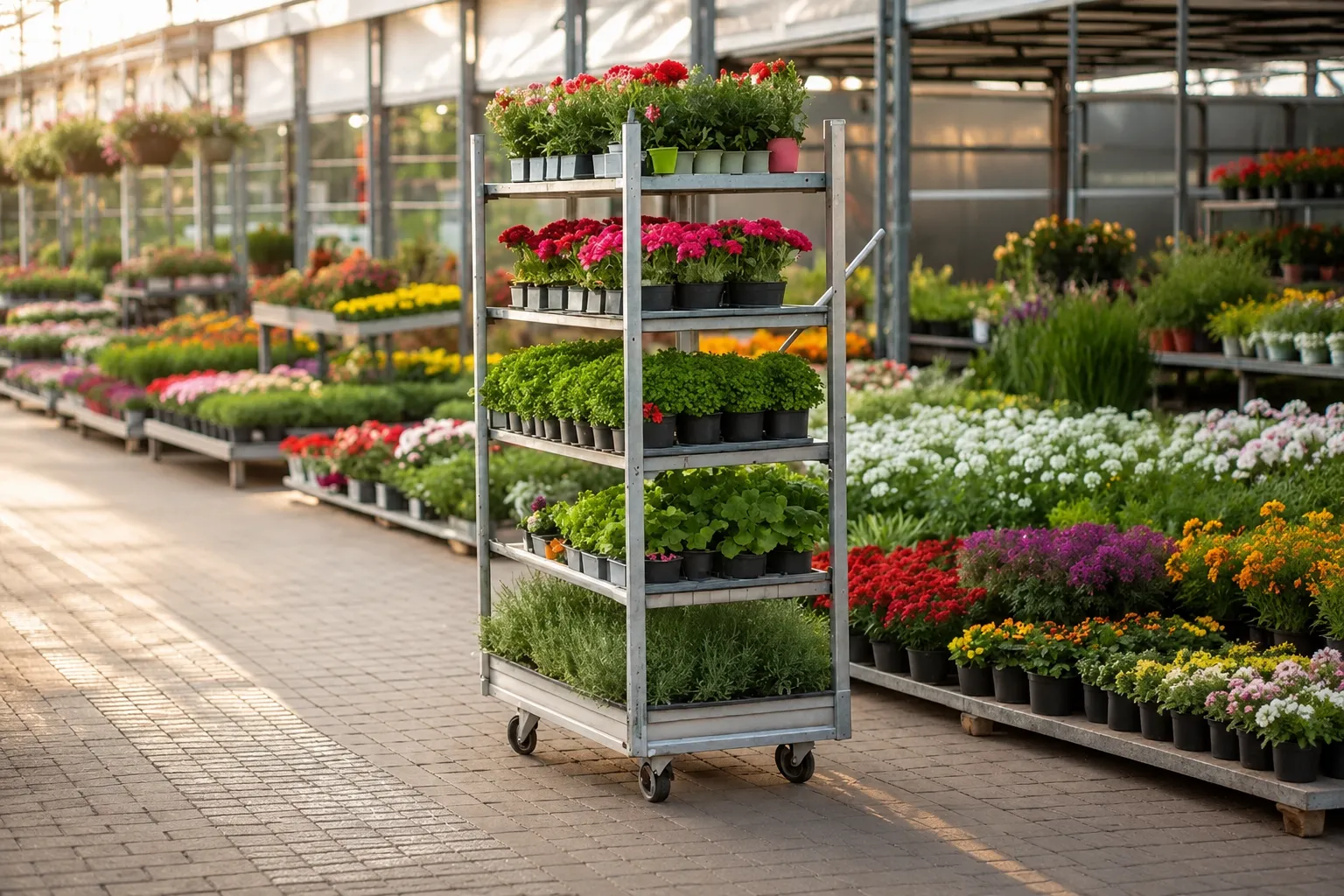
A Deense trolley is not only for back-end transport. It can also work as a retail flower display. Garden centers, supermarkets, florists, and plant shops can move the same trolley from stockroom to sales floor.
This saves handling time. Staff do not need to unload every plant onto a separate display stand. They can roll the trolley into place, adjust the shelves, and create a clean showcase. This is useful for daily replenishment and seasonal campaigns.
A flower trolley can support:
For garden centres and retail chains, a unified trolley style also supports brand image. The store looks organized. Customers find products faster. Staff can move displays when traffic changes.
When buying danish trolleys, buyers should not only compare pictures. They should compare structure, load capacity, finish, wheel type, packaging, lead time, and after-sales support. A lower unit price may become expensive if the trolley fails early.
First, confirm standard dimensions. Many buyers need trolleys that fit greenhouse aisles, shipping containers, warehouse doors, loading equipment, and retail spaces. If the size is wrong, the product may create problems in daily use.
Second, check whether you need a full-size model, half danish style, or a custom frame. A smaller trolley may fit tight retail areas. A larger model may improve capacity in a greenhouse or warehouse.
A trolley buyer often faces pressure to control cost. That is normal. But the lowest quote may not be the best value. If the frame is weak, the wheels fail, the finish rusts, or delivery is late, the final cost becomes much higher.
A reliable manufacturer supports stable welding, consistent dimensions, better packing, fast delivery, and repeatable quality. This is especially important in international trade, where replacement and complaint handling take more time.
For buyers who need high-quality danish trolleys, supplier selection should include factory capability, quality control, production experience, export packaging, and communication speed. A good supplier helps buyers avoid risk before shipment, not after problems happen.
A professional manufacturing plant can also help buyers buy new models for new retail layouts, greenhouse expansion, or updated logistics plans. This makes the supply relationship more valuable over time.
Hoektanden positions itself as a leading manufacturer of Danish trolleys, flower trolleys, garden carts, and metal racks for commercial users. For a wider company view, see Fangsheng’s manufacturing capability and company profile.
The same trolley can support various applications. In a greenhouse, it moves potted plants from growing areas to packing areas. In a nursery, it helps group orders. In a warehouse, it supports order picking and temporary storage. In municipal greening, it helps move plants to project sites.
The horticulture industry needs tools that are simple, strong, and flexible. A Danish trolley fits this need because it works across the full plant supply chain. It supports growing, sorting, storage, loading, selling, and delivery.
For a grower, the best product is not always the most complex one. It is the one that workers can use quickly, safely, and repeatedly. The same is true for wholesalers, retailers, and landscape contractors.
A good trolley helps the buyer answer three questions:
If the answer is yes, the trolley supports both operation and profit.
A Deense trolley is used for moving, storing, and displaying flowers and plants. It is common in greenhouses, nurseries, garden centers, supermarkets, logistics warehouses, and horticultural supply chains.
A normal cart is often a simple platform. A Danish trolley is more flexible. It usually has upright posts, removable shelves, strong wheels, and a modular frame. This makes it better for plant transport, storage, and display.
Yes. A professional manufacturer can customize size, shelf number, shelf spacing, wheel material, surface finish, logo, and packaging. This is useful for chain stores, nurseries, growers, and logistics buyers.
Yes. A galvanized finish helps protect the frame from rust, especially in humid greenhouse and outdoor conditions. Buyers can also choose powder coating for branding and visual display needs.
The best wheel depends on the floor, load, and working area. Polypropylene and nylon wheels are common for many commercial uses. Rubber, PU, or TPR wheels may be better where noise control or floor protection is important.
Check manufacturing capability, welding quality, load capacity, finish quality, sample testing, export packaging, delivery stability, and after-sales response. A reliable supplier should help you reduce total cost, not only provide a low quote.


 Dutch
Dutch  English
  German
  French
  Spanish
  Danish
  Norwegian
  Hungarian
  Turkish